
As your business grows, leadership becomes less about doing—and more about thinking.
Yet most business owners never make that shift.
They focus on:
- Fixing team performance
- Driving results
- Solving problems faster
But overlook the one factor shaping all of it:
How they show up as a leader.
In businesses with 15–100 employees, this becomes critical.
Because at that size:
- Your behaviour sets the tone
- Your decisions have significant ripple effects
- Your blind spots become organisational constraints
Self-awareness isn’t a personal development exercise.
It’s a leadership discipline.
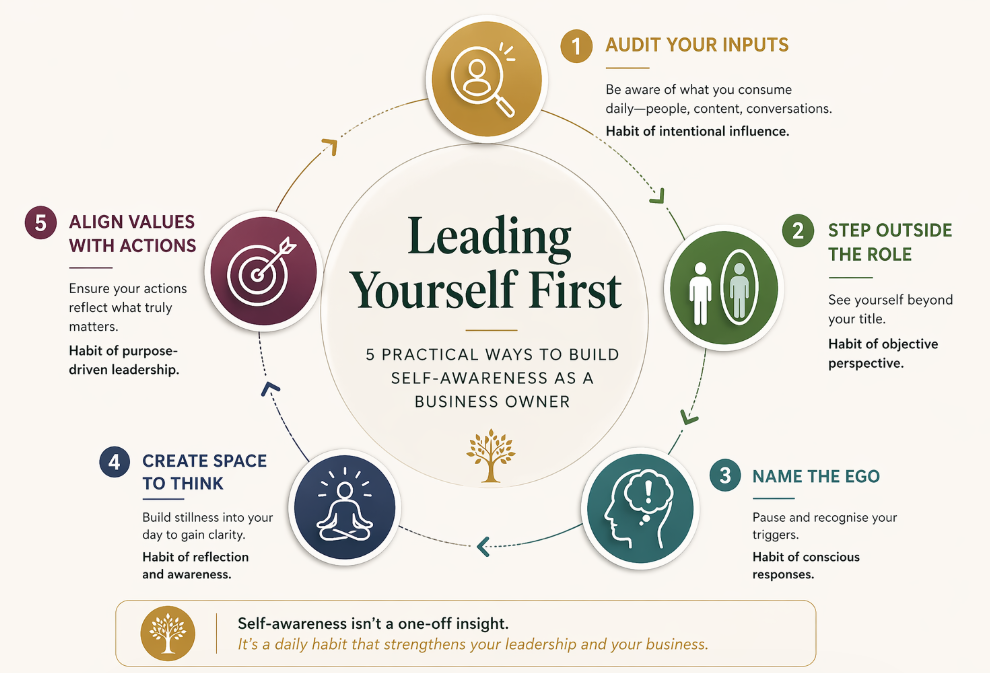
Here are five practical ways to build it.
1. Reflect on the Environment You Are Creating Before You Try to Fixing Others
One of our clients—a construction business owner—was frustrated with his leadership team.
“They’re so reactive. No one thinks ahead.”
But when we looked deeper, his environment told a different story.
- Constant firefighting
- Back-to-back meetings
- Conversations focused on problems, not planning
- Late-night emails pushing urgency
His team wasn’t underperforming.
They were responding to the environment he was creating.
Your leadership behaviour is conditioned.
What you consume daily—stress, conversations, expectations—shapes how you think and act.
Practical shift:
Track where and how you spend your time for one week:
- What conversations are you having?
- What content are you consuming?
- What pressures are you reinforcing?
Patterns will emerge quickly.
Because you can’t change leadership behaviour without changing what’s feeding it.
2. Separate Who You Are from What You Do
Many business owners unknowingly fuse identity with role.
“I am the business.”
“I have to have all the answers.”
“If something fails, it’s on me.”
This creates two problems:
- Feedback feels personal
- Objectivity disappears
We worked with a founder who struggled to delegate.
Every decision had to go through him.
When asked why, he said:
“If I’m not involved, things fall apart.”
But when we reframed the question:
“If you were an external advisor looking at your business, what would you say?”
His answer changed immediately:
“I’d say I’m the bottleneck.”
That’s the power of detachment.
Practical shift:
Step outside your role and ask:
- If I wasn’t the owner, how would I assess this leadership behaviour?
- What would my team say that I’m not seeing?
Self-awareness increases when identity loosens.
3. Recognise Ego Before It Drives Decisions
Ego doesn’t show up as arrogance.
It shows up as:
- Defensiveness in feedback
- Needing to control outcomes
- Holding onto being right
One client—a professional services firm owner—noticed tension in leadership meetings.
Discussions would shut down quickly.
When we unpacked it, the issue wasn’t capability.
It was his reaction to challenge.
When leaders pushed back, he would:
- Interrupt
- Justify decisions
- Close the conversation
Unintentionally, he trained his team to stop speaking up.
Ego was limiting leadership effectiveness.
The breakthrough came from a simple practice:
Label it in the moment.
“That’s my ego reacting.”
This creates a pause.
And in that pause—you get choice.
Practical shift:
Notice where your ego shows up most:
- Feedback
- Conflict
- Decision-making
Because awareness is where we start to interrupt the pattern.
4. Build Stillness Into Your Leadership Routine
Most business owners operate in constant motion.
- Meetings
- Emails
- Decisions
- Problems
There’s no space to think—only react.
But without reflection, patterns stay invisible.
One of our clients—a manufacturing business owner—implemented a simple habit:
10 minutes each morning.
No phone. No input. No agenda.
At first, it felt unproductive.
But within weeks, he started noticing:
- Recurring frustrations
- Decision patterns
- Emotional triggers
And more importantly—he started responding differently.
Clarity doesn’t come from more thinking.
It comes from less noise.
Practical shift:
Create daily space to observe your thinking.
Not to solve.
Just to notice.
Because you can’t change what you’re too busy to see.
5. Align Your Values Before You Set Your Goals
Many business owners set goals based on:
- Growth targets
- Industry benchmarks
- External expectations
But rarely stop to ask:
Does this align with how I want to lead?
We worked with a client scaling aggressively.
Revenue was increasing—but so was:
- Team turnover
- Stress
- Decision fatigue
When we explored his values, he identified:
- Family
- Sustainability
- Developing people
But his leadership behaviour reflected:
- Speed
- Pressure
- Short-term wins
The misalignment was creating friction—personally and organisationally.
When values and actions don’t align, leadership becomes inconsistent.
Practical shift:
Define your top 3-5 values. Then ask:
- Where is my behaviour aligned?
- Where is it not?
Because alignment simplifies decision-making—and strengthens leadership clarity.
Bringing It Together
Self-awareness is not a one-off insight.
It’s a continuous process.
When you build it intentionally:
- Your decisions become clearer
- Your reactions become measured
- Your leadership becomes consistent
And in a business of 15–100 people—that consistency matters.
Because your leadership doesn’t just affect outcomes.
It shapes the environment your entire team operates in.
Final Reflection
Before focusing on improving your team, ask:
👉 What am I currently unaware of that’s shaping how I lead?
Because the quality of your leadership is rarely limited by strategy.
It’s limited by awareness.