
One of the most common things I see in coaching is an owner who works long hours but never gets to the work that would actually grow the business. The day fills up with other people’s urgent requests, and the important work slides into the evening or the weekend.
The Eisenhower Matrix is a simple tool for fixing that. It sorts every task by two questions: is it urgent, and is it important? The answers put each task into one of four boxes, and each box tells you what to do with it.
What is the Eisenhower Matrix?
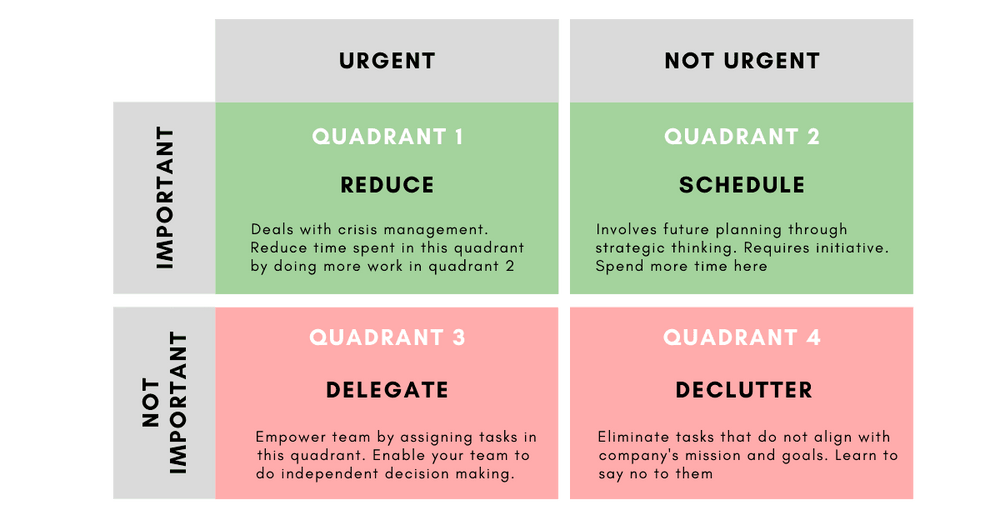
The Eisenhower Matrix (also called the urgent-important matrix or the Eisenhower Box) is a grid with two axes. One axis is urgency: does this need doing now? The other is importance: does this move the business or my role forward?
That gives four quadrants:
| Urgent | Not urgent | |
|---|---|---|
| Important | 1. Do first | 2. Schedule |
| Not important | 3. Delegate | 4. Delete |
Urgent tasks demand attention now, often because someone else is waiting. Important tasks contribute to your goals, even when nobody is chasing them. The skill is not mixing up the two.
Where the name comes from
The matrix is named after Dwight D. Eisenhower, US President from 1953 to 1961. In a 1954 speech he quoted a former college president: “I have two kinds of problems, the urgent and the important. The urgent are not important, and the important are never urgent.” Stephen Covey later made the grid popular in The 7 Habits of Highly Effective People.
The four quadrants
Quadrant 1: Do first (urgent and important)
Crises, real deadlines, a key client issue, a cash flow problem. Deal with these now. If this box is always full, that is a sign of a planning or delegation problem, not just a busy week.
Quadrant 2: Schedule (important, not urgent)
Strategy, developing your leaders, hiring well, building systems, your own health. This is where growth comes from, and it’s the box most owners neglect because nothing forces it. Book it in your diary like a client meeting.
Quadrant 3: Delegate (urgent, not important)
Most emails, routine approvals, many meetings, questions your team could answer. They feel pressing, but they don’t need you. Hand them to someone else and give that person the authority to decide.
Quadrant 4: Delete (not urgent, not important)
Low-value reports, meetings with no purpose, mindless scrolling. Cut or limit them. This doesn’t mean cutting rest. Real downtime belongs in Quadrant 2, because it’s important for how well you lead.
An example week for a business owner
Here’s how a typical week for an owner of a 50 person business might sort out:
| Task | Quadrant | Action |
|---|---|---|
| Key client threatening to leave | 1. Do first | Call today |
| Payroll issue due Friday | 1. Do first | Fix this week |
| Quarterly planning with the leadership team | 2. Schedule | Book a half day |
| Coaching session with a new manager | 2. Schedule | Recurring fortnightly |
| Approving every purchase under $500 | 3. Delegate | Give managers a spending limit |
| Answering staff questions on leave policy | 3. Delegate | Send to HR or ops lead |
| Reading every internal report | 4. Delete | Ask for a one-page summary |
How to use the Eisenhower Matrix
- List everything on your plate this week, work and personal.
- Ask two questions of each task: does it need doing now, and does it matter to my goals?
- Place each task in one of the four quadrants.
- Act on each box: do Quadrant 1, schedule Quadrant 2, delegate Quadrant 3, delete Quadrant 4.
- Review weekly. Tasks move between boxes as deadlines change.
Where owners get stuck
Everything feels like Quadrant 1. If every task is urgent, often the real issue is that decisions can only be made by you. That’s a leadership structure problem, and I wrote about it in you hired more people, so why is everything still landing on your desk?
Quadrant 3 never gets delegated. Owners hold onto these tasks because it’s quicker to do it yourself. It is, once. Over a year it costs you most of your Quadrant 2 time. Delegating well means handing over the decision, not just the task.
Quadrant 2 gets bumped. If your planning time keeps moving, block it out first each week before anything else goes in.
Frequently asked questions
What are the four quadrants of the Eisenhower Matrix?
Do first (urgent and important), Schedule (important, not urgent), Delegate (urgent, not important) and Delete (neither urgent nor important).
What are the drawbacks of the Eisenhower Matrix?
It doesn’t tell you how long a task will take or what order to do things in within a quadrant. It also relies on you being honest about what’s important. Many people label tasks urgent just because someone is asking. It works best combined with a weekly review.
How is urgent different from important?
Urgent means time-sensitive, often because someone else wants it now. Important means it contributes to your goals. A task can be one without the other.
Who should use the Eisenhower Matrix?
Anyone with more tasks than time. It’s especially useful for business owners and managers, because the matrix makes delegation decisions visible.
Still finding that everything comes back to you?
The matrix shows you what to delegate. Coaching helps you build the team and the habits to actually hand it over. Find out more about executive coaching in Sydney or book a time with Charlie.