
Here’s a conversation I have more than almost any other.
A business owner tells me they’ve got a talented team. Smart people. Hard workers. And yet somehow the business still runs through the owner, decisions still bottleneck is with the owner, and the leadership group that’s meant to be collaborating and sharing the load is quietly, or loudly, pulling in different directions.
They don’t have a talent problem. They have a right people problem.
Because a group of capable individuals is not a team. You can hire the best skills on the market and still end up with people who compete instead of collaborate, who protect their patch instead of building the whole. The difference between the two isn’t ability. It’s a set of traits most owners never screen for and never name when they’re missing.
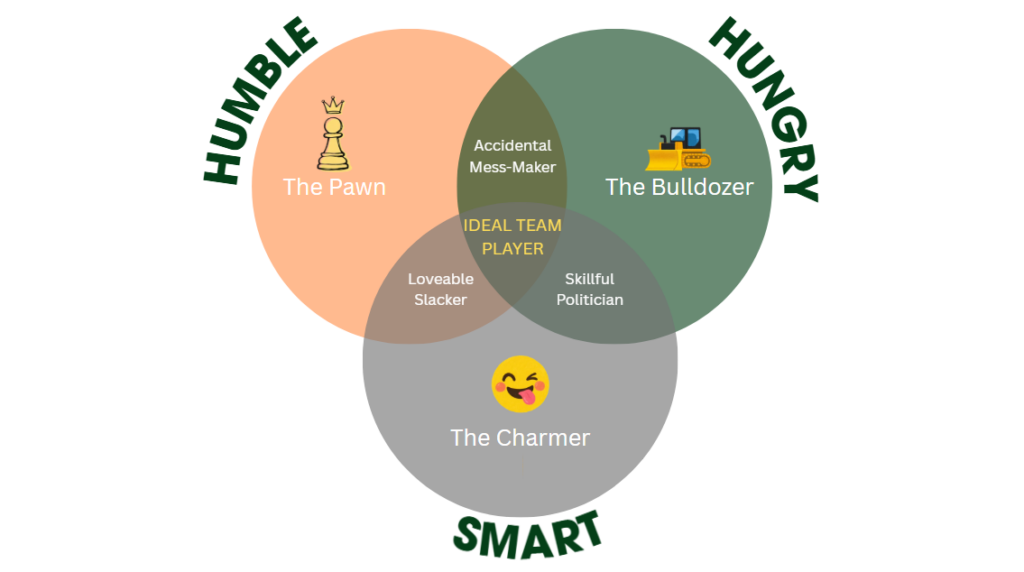
Patrick Lencioni calls them humble, hungry, and smart. Get all three, and collaboration takes care of itself. Miss one, and it quietly breaks. Here’s how to put that to work.
1. Hire for humble first – skills are teachable, ego isn’t
The most expensive hire you’ll ever make isn’t the one who can’t do the job. It’s the one who’s brilliant at it and makes everything about themselves.
Skills you can develop. Hunger you can sometimes coach. But humility – the willingness to share credit, put the team first, and admit when you’re wrong – is close to fixed by the time someone reaches you. And its absence poisons everything around it.
Watch for it early. How does a candidate talk about their last team – is it “I” or “we”? Ask them about a failure: humble people own it plainly, ego dresses it up as someone else’s fault. You’ve likely felt the cost of getting this wrong – the hire who looked perfect on paper and quietly cost the team months before you or someone else worked it out.
The practical shift: stop over-indexing on talent in your hiring and start screening, deliberately, for how someone shares credit.
2. Name the trait that’s missing – don’t tolerate the gap
When someone on your team isn’t quite working, it’s rarely all three virtues that are missing. It’s usually one. And the whole conversation changes the moment you can name which.
- Humble but not hungry: genuinely likeable, everyone roots for them, but you have to be the one pushing.
- Hungry and smart but not humble: they get results this quarter yet they leave damage in their wake.
- Smart but not hungry or humble: the skill full politician, managing perceptions while contributing little.
Most business owners feel the problem long before they can name it – they call it an “attitude issue” and manage around it for years. Naming the actual missing trait turns a vague frustration into a specific, coachable conversation.
The practical shift: stop managing a fuzzy “attitude problem” and start naming the one trait that’s missing.
3. Make collaboration a standard, not just hope
Even the right people need to know that working together is the expectation – not something you all are privately hoping for.
Most businesses reward the wrong thing without realising it. The individual top scorer gets the recognition; yet the leader who quietly coached three people through a hard week gets overlooked. If you do that long enough, you’ll be training your best people to hoard, not collaborate. Your business and/or team becomes what you reward/recognise – not what you ask for.
Celebrate when something is delegated. Call out the leader who developed someone instead of doing the work for them. Reward the person who lifted the team’s result, not just their own. Change what gets recognised in the room, and you’ll be surprised how quickly behaviour follows.
The practical shift: stop celebrating heroics and start celebrating delegation.
4. Look in the mirror first
Before you assess anyone else against these three traits, look into the mirror. Which of humble, hungry, and smart do you model when you’re under pressure?
This is probably going to be uncomfortable. Your team takes far more cues from how you behave than from anything you say. If you don’t encourage feedback when you’re stretched, you’ve just emphasised that humility is optional. If you swoop in (Superman) and solve everything yourself, you’ve taught them that hunger and initiative aren’t really wanted here.
Humble, hungry, smart can’t be a filter you apply to other people.
The practical shift: stop only auditing the team and start auditing your behaviour too.
The framework: Humble, Hungry, Smart
Lencioni’s model is powerful because it’s simple enough to use each week on a Monday morning. Hold each of your leaders – and yourself – against three questions:
- Humble – do they share credit and put the team ahead of their own ego?
- Hungry – are they self-motivated, or do they need pushing?
- Smart – are they people-smart: do they read the room and know how they land?
The insight is in the overlaps.
- Someone humble and hungry but not smart means well yet still creates friction.
- Someone hungry and smart but not humble is the one to watch most closely – capable, convincing, and quietly costly.
It’s the presence of all three that makes collaboration effortless.
Four questions to sit with
- Do I actually know which of the three virtues each of my leaders is strongest and weakest in?
- Am I tolerating someone whose output is good and whose impact on the team isn’t?
- What do I reward in this business – individual heroics, or people who make others better?
- Which of the three do I model worst when I’m under pressure?
If those questions landed, that’s the work. And it’s exactly what we build in the Leaders To Create Future Leaders Program on 10–11 & 25 September 2026 – where your leaders learn to spot the right people, develop the ones around them, and build the structure and shared language that let a whole team collaborate, instead of leaning on you to hold it together. We keep the group small on purpose.
If you’ve got leaders ready to build a real team – not just manage one – this is for them.
Developing leaders who create leaders.