
For most business owners, growth doesn’t stall because of strategy—it stalls because of how you’re leading yourself day to day.
When you’re running a business with 15–100 people, your influence is everywhere.
Your decisions shape direction.
Your behaviour sets the tone.
Your energy impacts the whole system.
Which means this is true whether you like it or not:
The ceiling of your business is directly linked to how well you lead yourself.
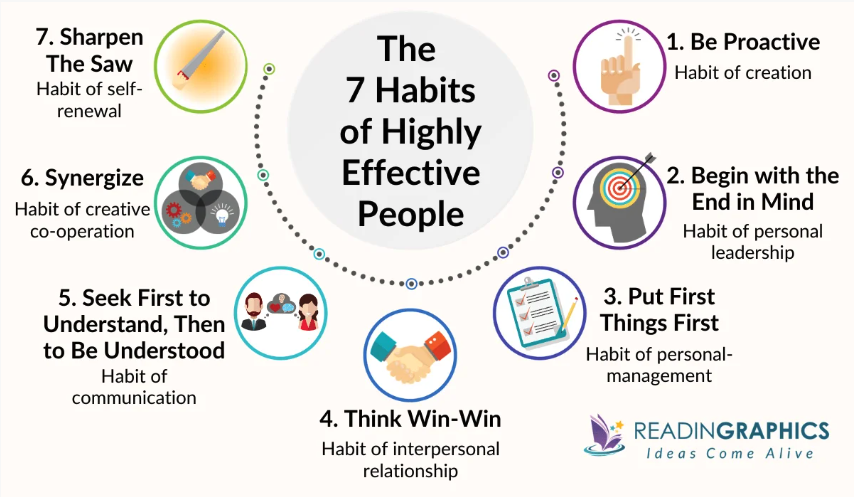
Stephen Covey’s 7 Habits of Highly Effective People has stood the test of time for a reason—it focuses on principles, rather than tactics. And when applied well, its a powerful way for individual growth that scales into business performance.
Here are five habits, reframed specifically for you as a business owners, that will strengthen how you lead yourself—and therefore your business.
1. Be Proactive — Stop Managing Circumstances, Start Leading Your Response
In growing businesses, it’s easy to fall into reactive mode:
- A key employee resigns
- A client pushes back
- Cash flow tightens
- The team needs you everywhere at once
Before long, you’re spending your days reacting or responding instead of leading.
Covey’s first habit is simple, but not easy:
You are responsible for your response—always.
The most effective leaders we work with aren’t the ones with fewer problems.
They’re the ones who have built the discipline to pause, choose, and respond deliberately.
Example:
A director we worked with in a professional services firm noticed he was constantly firefighting team issues. His default was to jump in and fix (he felt good been seen as Superman).
We challenged him to pause and ask:
“What is my role here—rescuer or leader?”
That one shift led him to start coaching (been Yoda) instead of solving. Within months, his team stepped up—and his workload dropped.
Growth question:
Where are you reacting out of habit instead of choosing your response?
2. Begin With the End in Mind — Get Clear on What You’re Actually Building
Many business owners start with a clear vision. But somewhere along the way, growth becomes… busy.
More clients. More people. More complexity.
But not necessarily more clarity.
Covey’s second habit forces a reset:
If you don’t define where you’re going, you’ll drift into whatever demands your attention.
For business owners, this isn’t just about revenue targets. It’s about:
- The kind of business you want to run
- The type of leader you want to be
- The culture you’re building
Example:
One Orchard Coaching client had built a successful 40-person business—but felt constantly stretched and disconnected.
When we explored his “end in mind,” he realised:
- He didn’t want to be the bottleneck
- He wanted a leadership team that could operate independently
- He wanted time to think, not just do
That clarity reshaped his decisions:
- He invested in leadership development
- Stepped back from operational detail
- Rebuilt his role around strategy
Growth question:
Are you building the business you actually want—or just growing what already exists?
3. Put First Things First — Align Your Time With What Actually Matters
This is where most leaders fall down.
You know what matters (important):
- Developing your leaders
- Thinking strategically
- Strengthening culture
- Building sustainability
But your week fills with:
- Emails
- Meetings
- Urgent issues
- Operational noise
Covey’s point is sharp:
Your priorities are revealed by your calendar—not your intentions.
Example:
A business owner we worked with said leadership development was critical—but had zero time allocated to it.
I had him agree to start by blocking out two hours every fortnight for 1:1 coaching with his direct reports.
At first, it felt “unproductive.”
Within 3 months, performance improved by those he coached, decision-making sped up, and team accountability increased.
The “non-urgent” work became the highest leverage activity in the business.
Growth question:
What are you saying matters—but not prioritising in your calendar?
4. Seek First to Understand — Build Awareness Before You Act
As a business owner, you’re used to solving problems quickly.
But speed often comes at the cost of understanding and/or learning.
This habit is usually framed around others—but it’s just as powerful when applied inward.
If you don’t understand your own patterns, you’ll keep repeating them.
Example:
A founder we worked with kept experiencing tension with his leadership team. His view was:
“They’re just not stepping up.”
Through coaching, he realised:
- He was unclear in expectations
- He stepped in too quickly
- He avoided difficult conversations
The issue wasn’t capability—it was his leadership pattern.
Once he saw it, everything changed:
- Clearer expectations
- More direct feedback
- Greater ownership in the team
Growth question:
What patterns keep showing up in your leadership—and what might they be telling you?
5. Sharpen the Saw — Build a System That Sustains You
This is the habit most leaders ignore—until it becomes a problem.
You push hard.
You carry responsibility.
You keep going.
But over time:
- Your thinking becomes reactive
- Your patience shortens
- Your energy drops
And it shows up across the business.
Covey’s principle is simple:
You can’t lead effectively if you’re depleted.
Example:
One business owner described himself as “constantly on.”
No space. No reset. Always thinking about the business.
We worked on building a simple renewal rhythm:
- Weekly time away from operations
- Regular physical activity
- Time to think strategically
The result wasn’t just better wellbeing—it was better decision-making and clearer leadership.
Growth question:
What are you doing consistently to renew your energy—not just escape your work?
Bringing It Together: Leading Self is the Leverage Point
These habits aren’t separate—they compound.
- When you’re proactive, you stop being controlled by circumstances
- When you’re clear on the end, your decisions sharpen
- When you prioritise well, your time aligns with growth
- When you understand your patterns, you lead more effectively
- When you renew your energy, you sustain it all
For business owners, this isn’t personal development for its own sake.
This is about building a business that doesn’t rely on you being at your limit to succeed.
Final Thought
If there’s one place to start, it’s this:
Look at your last two weeks.
Not what you intended—but what you actually did.
That’s your current standard of self-leadership.
The good news?
Standards can change—quickly—when awareness meets action.