
Inspired by Scaling Up by Verne Harnish
There’s a conversation I have regularly with business owners who are frustrated with their team’s performance.
They’ve invested in good people. They’ve worked hard to build a positive culture. But something keeps going wrong — decisions are slow, accountability is patchy, and the business feels like it’s being held together by a few key people who are running dangerously close to empty.
When I dig into what’s actually happening, the issue is almost never just the people themselves.
It’s that the right people aren’t in the right roles — doing the right things.
Verne Harnish makes this the centrepiece of one of the four core decisions every scaling business must get right. In Scaling Up, he’s direct: you cannot build a great business on a misaligned team. And misalignment, more often than not, isn’t about attitude or effort. It’s about structure.
The Four Core Decisions — And Why People Comes First
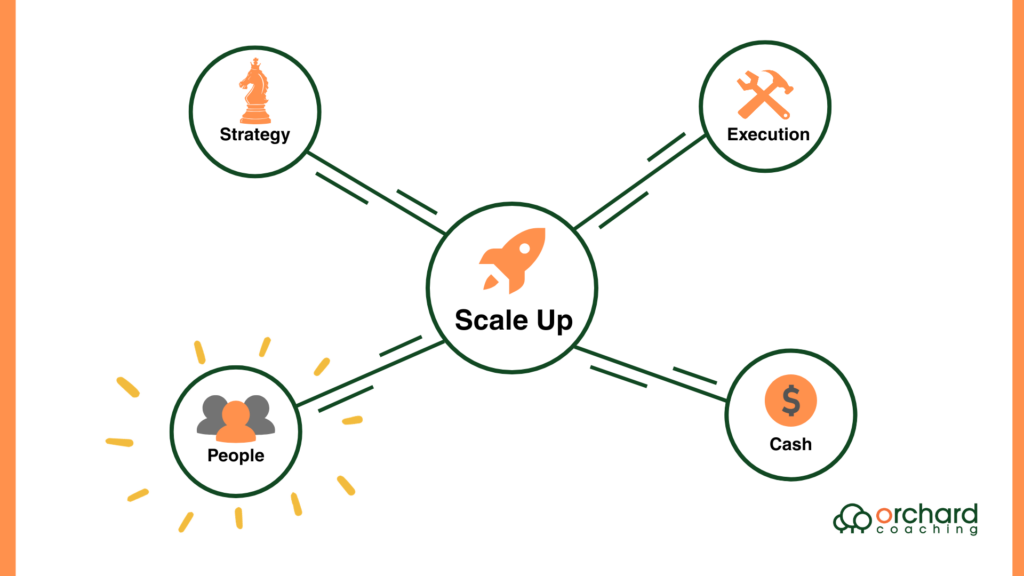
Harnish’s framework in Scaling Up identifies four decisions that determine whether a business scales well or stalls: People, Strategy, Execution and Cash.
Most business owners instinctively focus on the bottom three. Strategy feels important. Execution feels urgent. Cash is always front of mind.
But Harnish is emphatic: People is the foundation. Get it wrong, and the other three decisions are harder than they need to be. Get it right, and everything else has a fighting chance.
The People decision isn’t just about hiring well. It’s about three interconnected questions that most businesses never ask clearly enough:
- Do you have the right people — those who share your values and fit your culture?
- Are they in the right seats — roles that match their strengths and the needs of the business?
- Are they doing the right things — with clear priorities, accountability and a genuine understanding of what success looks like in their role?
When the answer to all three is yes, businesses move faster, leaders feel lighter, and culture strengthens almost automatically. When the answer to even one is no, the whole system strains.
The Most Common Misalignment Leaders Miss
In my experience working with growing businesses, the most costly people problem isn’t a bad hire. It’s a good person in the wrong seat.
It looks like this: a high-performer who thrives operationally gets promoted into a strategic leadership role — and struggles. A detail-oriented manager gets put in charge of business development — and freezes. A founder who is brilliant at vision keeps getting pulled into the day-to-day — and burns out.
None of these are character failures. They’re structural ones.
Harnish uses the language of “right seat” deliberately. A seat isn’t just a job title. It’s the intersection of three things: what the business needs from the role, what the person is genuinely great at, and what energises rather than drains them. When all three align, performance becomes almost effortless. When they don’t, even your best people will underperform — and often blame themselves for it.
What Getting People in the Right Roles Actually Requires
This is where many businesses stall. They recognise the misalignment but don’t know how to address it without damaging relationships or losing good people in the process.
Here’s what Harnish’s framework points to — and what I’ve seen work in practice:
1. Get clear on what each role actually needs — before you evaluate who’s in it.
Most role descriptions describe tasks, not outcomes. Rewrite them around the results the role needs to produce, the decisions it needs to own, and the strengths it requires. Only then can you honestly assess whether the right person is sitting in it.
2. Separate values fit from role fit — and be honest about both.
Someone can share your values completely and still be in the wrong seat. These are two different conversations. Conflating them leads to keeping people in misaligned roles out of loyalty — which ultimately serves no one.
3. Have the right seat conversation before the performance conversation.
If someone is consistently underperforming, ask whether the role itself is the problem before concluding the person is. In many cases, the same individual in a better-matched role becomes one of your strongest contributors.
4. Build your org chart around the business you’re becoming — not the one you are today.
Harnish encourages leaders to design the structure their business needs at the next stage of growth, then assess honestly whether the current team can step into it. This isn’t about replacing people — it’s about being clear on what the business needs and having genuine conversations about who wants to grow into it.
5. Review people decisions as regularly as you review financial decisions.
Most businesses review their P&L monthly. Very few review their people structure with the same discipline. Harnish recommends treating people decisions as a regular leadership agenda item — not a once-a-year HR exercise.
The Leadership Cost of Getting This Wrong
There’s a less visible cost to role misalignment that doesn’t show up in a spreadsheet — but every leader feels it.
When people are in the wrong seats, leaders compensate. They step in, pick up the slack, make decisions that should belong to someone else. Over time, this creates exactly the kind of overload and over-reliance we explored last month. Leaders can’t focus on what matters most because they’re too busy managing the gaps created by structural misalignment.
Getting people in the right roles isn’t just a people strategy. It’s how leaders reclaim their own focus — and create the conditions for the business to grow without them at the centre of everything.
A Diagnostic Worth Running
Before your next leadership team meeting, ask yourself honestly:
- Is everyone in my leadership team in a role that matches their genuine strengths?
- Are there any roles where performance issues might actually be a seat problem?
- If I were designing my leadership structure from scratch today, would it look the same as it does now?
These aren’t comfortable questions. But they’re the ones that tend to unlock the most meaningful change.
As Harnish puts it — the goal isn’t just to have great people. It’s to have great people doing the right work, in the right structure, with the right clarity about what they own.
That’s when a business stops relying on heroics and starts running like a team.
Developing leaders who create (future) leaders