
Here’s how it usually goes.
You’ve hired good people. Some of them you’ve promoted into leadership roles. On paper, the structure is there. But somehow the questions still find their way to you. “Can I go ahead with this?” “What do you want me to do here?” “Just checking before I send it.”
So you answer. Quickly, because you’re good at it. And every answer quietly teaches your team the same lesson: the thinking happens at the top.
The cost isn’t obvious at first. Then it is. Decisions queue behind your calendar. Your leaders become very capable messengers. And the moment you step away, things stall or drift in five different directions.
That’s not a people problem. It’s an alignment problem. Your team doesn’t lack capability. They lack the clarity and the authority to act without you.
David Marquet learnt this the hard way. When he took command of the USS Santa Fe, a nuclear submarine ranked among the worst performers in the US fleet, he’d been trained on a different class of boat. Early on he gave an order that couldn’t be carried out on that submarine, and the crew passed it down the line anyway. Nobody questioned it. That’s when he realised he’d inherited a crew trained to follow, not to think.
What he did next is told in Turn the Ship Around!, and it’s one of the most practical books I know on building a culture where leaders create leaders.
Here are four shifts from it that apply directly to a growing business.
1. Change the language from “permission” to “intent”
Marquet banned his officers from asking permission. Instead, they came to him with “Captain, I intend to…” and he would reply “Very well,” or ask a question.
It sounds like a small change in wording. It isn’t. To say “I intend to,” you have to think the problem through first, look at the options, and own the call.
- Notice how often your leaders ask “Can I…?” or “What should I do?”
- Invite them to come with “I intend to… because…” instead
- Your job becomes listening for gaps in their thinking, not supplying the thinking
The practical shift: stop giving answers and start hearing intentions.
2. Move decisions to where the information is
In most businesses, information travels up to the person with authority. By the time it arrives, it’s late, filtered and missing context. Marquet flipped this. Instead of moving information to the authority, he moved the authority to the information.
The people closest to the client, the job and the problem usually understand it better than you do. They just haven’t been given the call.
- List the decisions that still come to you out of habit, not necessity
- For each one, ask: who closer to the work could make this?
- Hand over one decision this month, with clear boundaries on what’s in and out of scope
Think of a rugby captain. Once the whistle blows, the coach can’t run onto the field and call every play. The game plan is set at training. On the field, the players read what’s in front of them and make the call. If the plan is clear, they make the right one.
The practical shift: stop being the decision bottleneck and start being the decision designer.
3. Build clarity before you hand over control
This is the step most owners skip, and it’s why delegation so often goes wrong. Marquet was clear that you can’t just hand over control. If people don’t understand the purpose behind the work, giving them authority just means each person pulls in their own direction.
Alignment comes from people making decisions against the same picture of what good looks like.
- Does everyone know the top 3–5 priorities, and why they matter?
- Would your leaders describe “a good decision” the same way you would?
- When a leader makes a call you wouldn’t have made, is it a capability gap or a clarity gap?
If the honest answer to any of these is “probably not,” that’s where to start.
The practical shift: stop delegating tasks and start sharing the purpose behind them.
4. Certify, don’t brief
Most leaders brief their team. They stand up, explain the plan, ask “Any questions?”, and take silence as understanding.
Marquet replaced briefings with certifications. Before a task, the team explained the plan back to him: what they’d do, why, and what could go wrong. If they couldn’t, they weren’t ready yet.
- After you share a plan, ask your leaders to walk you through it in their own words
- Ask “What could go wrong, and what will you do if it does?”
- Listen for the gaps, and resist filling them yourself
It feels slower at first. It’s far faster than finding the gaps after the work is done.
The practical shift: stop checking whether they heard you and start checking whether they’re ready.
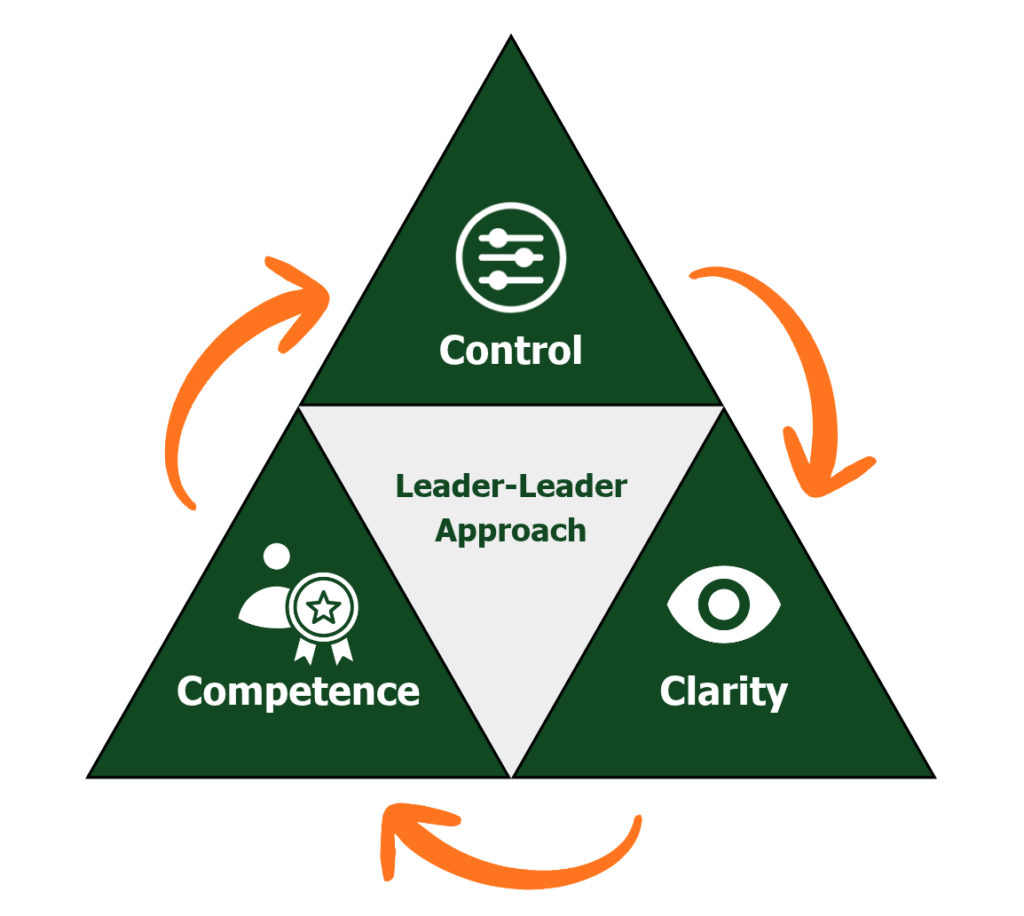
The Framework: Leader-Leader
Marquet describes two ways to run a team. In a leader-follower model, a few people think and the rest carry out instructions. It works, for as long as the leader is in the room. In a leader-leader model, everyone thinks and acts like a leader.
He says getting there takes three things, and you need all three:
- Control: push decision-making down to the people doing the work.
- Competence: make sure they have the knowledge and skills to decide well.
- Clarity: make sure everyone understands the purpose, so their decisions line up.
Control without competence is risky. Control without clarity means everyone heads off in a different direction. When all three are in place, you get alignment that holds without you.
It worked. Under Marquet, the Santa Fe went from among the worst submarines in the fleet to among the best. More tellingly, it kept producing officers who went on to command their own boats, long after he’d left.
If every decision needs you, you haven’t built a team. You’ve built a queue.
Where Does Your Business Sit?
Ask yourself honestly:
- When your leaders bring you a problem, do they bring their intended solution, or wait for yours?
- Which decisions still come to you that someone closer to the work could make?
- If you asked three leaders to name the top priorities and why they matter, would you get the same answer?
- After you share a plan, how do you know your team is ready, not just that they heard you?
If two or more of these made you wince, you’re not alone. It’s the most common pattern I see in businesses moving from 30 to 100 people.
Building Leaders in 2027
The Future Leaders Program (From Expert to Example) helps emerging leaders build the self-awareness, trust and influence to step up, with or without the title.
It runs in person in Sydney on 4 & 5 March 2027, or online on Tuesdays from 3 August to 26 October 2027.
We keep the groups small on purpose. If you’re not sure who in your team fits where, let’s talk it through.
New for 2027!
Are your team leaders developing their people, or still doing the work for them?
Future Team Leaders Program: From Doer to Enabler
In person, Sydney: Thursdays, 18 March & 6 May 2027 & Online: Wednesdays, 11 Aug to 17 Nov 2027
- For team leaders and supervisors who are still doing the work and need to get results through their people.
- They learn to delegate outcomes rather than tasks, to coach in one-on-ones instead of rescuing, and to have the hard conversation.
- For you: issues handled before they reach your desk.
Developing leaders who create leaders.