
Most of the business owners I work with aren’t short of leadership concepts and ideas to try in their business. They’re short of time to sit with any of them to see if they are the one they need to implement now to it makes a significant impact in their context. So the book gets bought, it sits on their desk for a few months, and eventually it goes on the shelf with the others.
I’ve shared a book in the Orchard Coaching monthly newsletter each month this year (sign-up here), and I wanted to share the five which I really want you to read and to sit with. The ones I keep bringing up in sessions because they say something an owner of a 40-100 person business actually needs to hear.
My advice hasn’t changed since the last time I wrote one of these: read, reflect, talk it through with someone, then give a couple of things a go. A book you’ve argued about with your leadership team is worth ten you’ve finished on your own.
- The 7 Habits of Highly Effective People by Stephen Covey
- Essentialism by Greg McKeown
- The Ideal Team Player by Patrick Lencioni
- Rocket Fuel by Gino Wickman and Mark C. Winters
- The Invisible Leader by Zach Mercurio
1. The 7 Habits of Highly Effective People – Stephen Covey
Everyone’s heard of it. Far fewer have read it properly, which is a shame, because Covey makes an argument that most leadership content skips: effectiveness comes from principles, not techniques.
What I keep coming back to is his progression from dependence to independence to interdependence. You have to build your own discipline, clarity and sense of responsibility before you can lead anyone else well. Your team will not operate at a level you don’t demonstrate yourself. That’s confronting, and it’s also where the work starts.
Read it if you want the foundation under everything else on this list.
2. Essentialism – Greg McKeown
The owners I meet aren’t lacking commitment. They’re lacking room to think. The diary is full, the day gets away from them, and the important work keeps sliding into the evening.
McKeown’s case is that doing less, but better, is a discipline rather than a luxury – being deliberate about where your time goes, and getting comfortable saying no to things that are perfectly good but not yours to carry. For an owner who’s proud of being capable of doing everything, that’s a harder read than it sounds.
Read it if you’re stretched across everything and quietly wondering what you’d drop if you were honest about it.
3. The Ideal Team Player – Patrick Lencioni
Once you’re leading yourself reasonably well, the question becomes whether you’ve got the right people around you and whether you can say out loud what “right” actually means.
Lencioni tells it as a story, which makes it an easy read, and lands on three virtues: humble, hungry and people smart. It gives you and your leaders shared words for hiring, for development conversations, and for the discussion about someone who’s good at the job but hard on everyone around them. That conversation is usually the one being avoided.
Read it if you’re hiring, reshaping a team, or sitting on a conversation you know you need to have.
4. Rocket Fuel – Gino Wickman and Mark C. Winters
Right people is only half of it. They also need to be in the right seats, and in most growing businesses the seat causing the trouble is the owner’s.
Rocket Fuel looks at the Visionary and Integrator partnership and why a business that’s scaling needs both, rarely in the same person. If you’ve ever finished a week knowing that nearly every decision came through you, this one will sting a bit and then be useful.
Read it if you suspect you’re holding roles that should belong to someone else.
5. The Invisible Leader – Zach Mercurio
This is the one I’d press on you if you only picked up a single book from the list.
Mercurio’s argument is that purpose is the invisible leader. It’s what guides how your people behave when you aren’t in the room, which is most of the time once you’re past thirty or forty staff. He’s not talking about a values statement on the wall. He’s interested in purpose that’s genuinely understood, so your team can make a call on a Tuesday afternoon without ringing you.
For an owner trying to build something that outlasts them, that’s the whole game. Your purpose leads when you don’t.
Read it if you want the business to hold its shape without you in the middle of it.
Worth a mention: Scaling Up by Verne Harnish, Think Like a Monk by Jay Shetty, and The Culture Code by Daniel Coyle all featured this year and worth considering.
What all five are really pointing at:
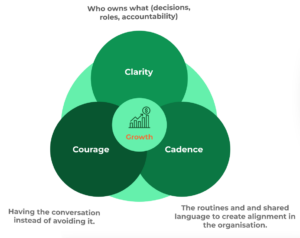
Read these back to back and the same three things keep surfacing. They’re the three I use to work out what’s actually broken in a growing business.
Clarity is who owns what. Decisions, roles, accountability. Without it, decisions stall, get made twice, or quietly don’t get made at all, and your leaders start checking with you to be safe.
Courage is having the conversation instead of avoiding it. The feedback you’ve been sitting on since August. The manager who isn’t cutting it. The honest look at your own blind spots. None of the clarity in the world helps if nobody will name the thing.
Cadence is the rhythm and shared language that keep everyone rowing in the same direction and that make it safe for anyone to ask the question nobody wants to ask out loud. It’s what turns a good conversation into a way of operating rather than a good week.
Growth needs all three, and you can feel it when one’s missing.
- Courage without clarity is confronting people with no direction to give them.
- Clarity without cadence is a plan that fades by the third week.
- Cadence without courage is a diary full of meetings where the real issue never gets named.
Most owners I work with are strong in one or two. The growth usually sits in the one they avoid.
So, honestly – which of the three is weakest in your business right now? And what is it costing you?
If that question’s a hard one to sit with, I’d welcome a conversation. Email me at ch*****@*************ng.com or grab a time here.
Developing leaders who create leaders.